
Managing Automations
Find, edit, monitor and troubleshoot your automations
Once you've built an Automation
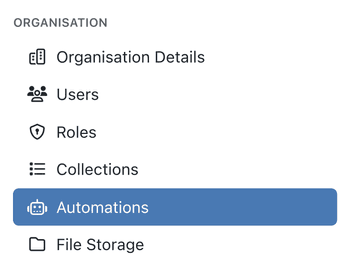
Automations are managed under Settings → Operations → Automations. You'll need to be a System admin.
1. Find your automations
1. Open the Automations pane
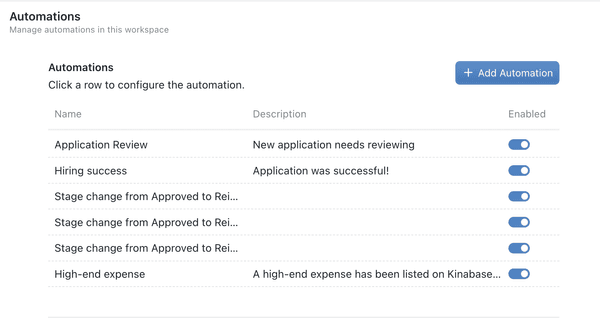
Open Settings, and under Operations select Automations. Every automation in your organisation is listed here.
2. Add or open an automation
Click Add Automation to create one, or use a row's options menu (⋯) for Edit, View History, Duplicate, Enable / Disable, and Delete.
2. Enable and disable
An automation runs only while it's enabled. To pause one without losing its configuration, open its menu and select Disable; select Enable to switch it back on. Disabling is the safe way to stop an automation temporarily while you investigate or make changes.
3. Read the run history
Every time an automation fires, Kinabase records the outcome. Open an automation and select the History tab to see each run, along with statistics on how often it has succeeded or failed.
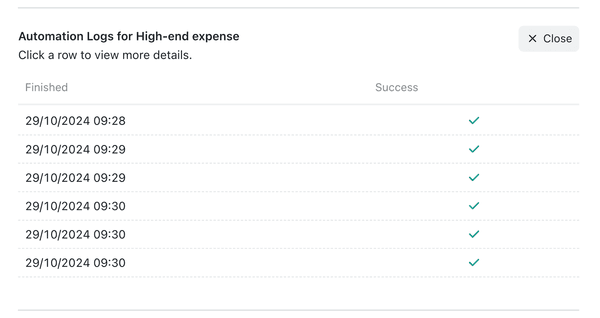
Each history entry carries a status:
| Status | What it means |
|---|---|
| Success | The automation ran and all its steps completed. |
| Filtered | The trigger fired, but the automation's conditions weren't met, so no steps ran. |
| Skipped | The run was suppressed to prevent a loop - for example, an automation re-triggering itself. |
| Failed | A step could not complete. The record name and error message are shown so you can diagnose it. |
| Next run postponed | The run completed, and Kinabase moved its next booking to a day after the run was due. This entry isn't counted in Total Runs or Success Rate. |
A Filtered result is usually expected behaviour, not a fault - it means your conditions are doing their job. A Failed result is the one to investigate.
4. Running an automation on many records at once
A Manual (right-click) automation can be run across a batch of records in one go.
1. Select the records
In a collection, tick several records - or Shift-click to select a range.
2. Run the automation
Right-click and choose the automation. A preview shows how many records were selected, how many will run, and how many are filtered out by the automation's conditions.
3. Review the results
Click Run, then review the summary of how many records completed, failed, or were filtered. Any failures list the record name and error for easy troubleshooting.
Running an automation across many records at once depends on your plan. If it's limited on your plan, Kinabase tells you when you try.
5. Troubleshooting and testing
When an automation doesn't do what you expect, work through these checks:
Is it enabled?
A disabled automation never runs. Confirm its status in the Automations list.
Did the trigger actually fire?
Check the History tab. If there's no entry, the trigger event didn't occur - for example, a Specific Field on a Record Updated trigger wasn't the field that changed.
Was the run Filtered?
A Filtered status means the conditions excluded the record. Re-read your conditions against the record's values.
Did a step Fail?
Open the failed run to read the error and the record it affected. Common causes are a missing required value, a step that needs an integration that isn't connected, or an external system rejecting an API call.
Test on a single record first. Create or edit one record that should trigger the automation, then check the History tab to confirm each step ran as intended before relying on it at scale. This matters most for steps that reach outside Kinabase, such as Send an email and Make an API call.
Importing records?
When you import records from a CSV file, Kinabase warns you before starting if any automations will not run for the imported records - the import screen lists them under "For this import, these automations will be skipped". If you need those automations to apply, run them manually afterwards using a Manual trigger, or update the affected records to fire their triggers.
6. Best practices
Begin with a few clear automations. Overcomplicating from the outset makes problems hard to trace.
A descriptive name - "Notify finance on new invoices" - tells your team what an automation does at a glance.
Check run history periodically so failures are caught early rather than discovered by their absence.
Let a Stage Change trigger handle the follow-up work whenever a record advances through its workflow.
Need more help? Ask your System admin, or contact our support team via Help & Support.