
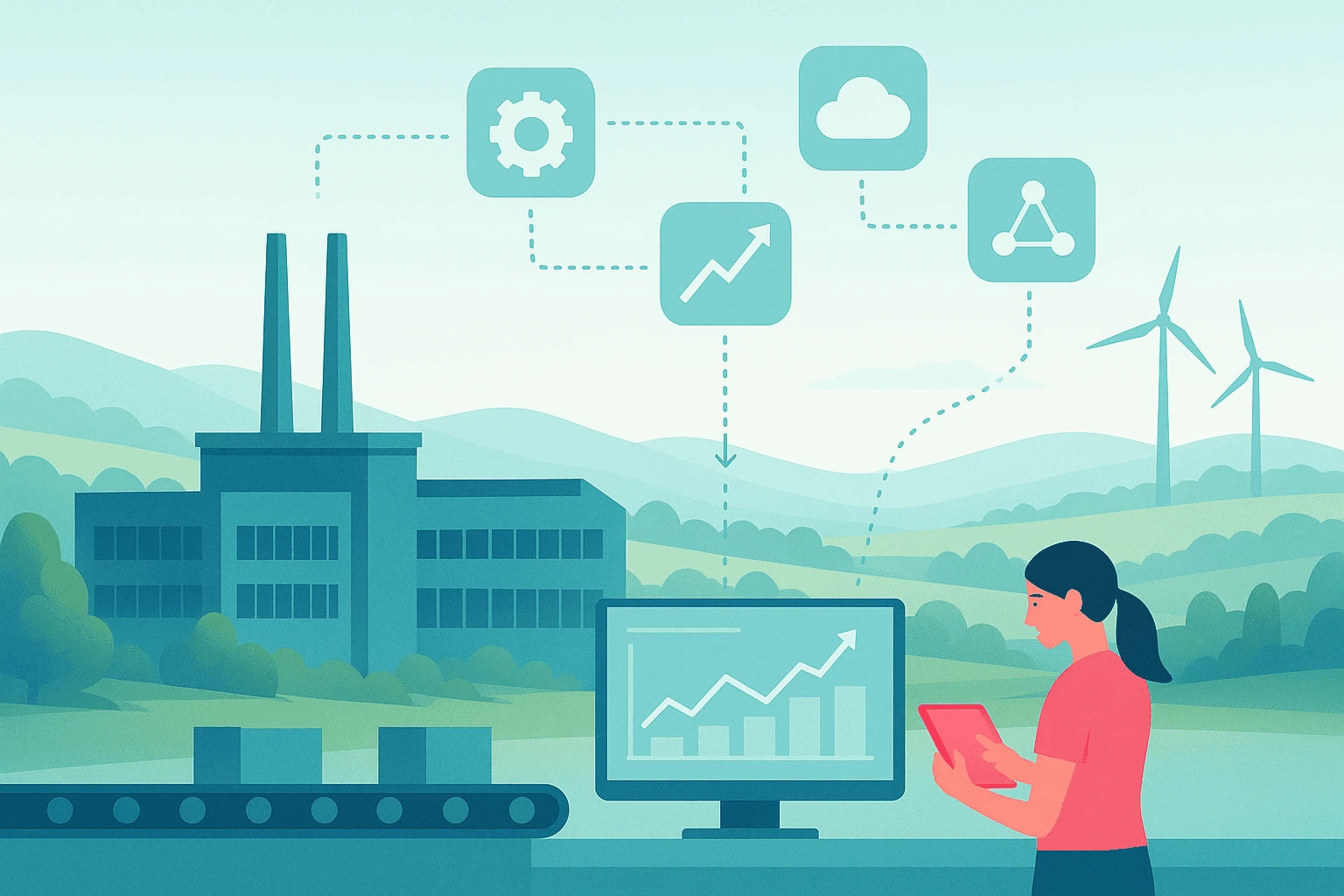
Customising Your Digital System for Long-Term Growth
Why Flexibility Matters – And How Kinabase Enables It
Every manufacturing business is different. Whether it’s bespoke workflows, niche quality metrics, or unique scheduling methods, no off-the-shelf system will be a perfect fit without some degree of adaptation. As manufacturers continue to digitise their operations, selecting software that evolves with their needs becomes essential for long-term success.
In this article, we explore why customisation is critical, how Kinabase’s spreadsheet-like adaptability stands out, and how a flexible system supports continuous improvement.
Why One Size Doesn’t Fit All
Enterprise software often promises standardisation, but rigid systems can quickly fall short for businesses with specialised needs. A company might have unique design-to-order workflows or compliance protocols. If the software cannot reflect these, the business must either adjust its processes, risking inefficiency, or patch the gaps with spreadsheets.
This misalignment is more than a nuisance. It can erode what makes your business competitive. If you’re forced to conform to inflexible systems, you lose agility. Conversely, when your software adapts to you, it preserves your uniqueness and ensures consistency across your teams.
This flexibility is where Kinabase shines.
Rather than imposing a set way of working, it allows manufacturers to build digital structures around how they already operate. You might start by tracking jobs and materials, then scale up to more complex needs, such as maintenance logging or sustainability reporting, without needing to change platforms.
This flexibility enables businesses to avoid common pitfalls in digital transformation outlined by Yogi Schulz. Not only enabling paper-based processes to be easily digitised, but also ensuring that the digital system reflects the actual workflows and needs of the business. This versatility helps address challenges with overlapping & legacy systems, collaboration across departments and integration with exisiting processes.
Flexibility That Feels Like a Spreadsheet
Spreadsheets are still widely used because of their adaptability. You can add a column, create a formula, or restructure layouts in seconds. Traditional enterprise software, by contrast, often requires IT intervention even for minor changes.
Kinabase bridges that gap. As its developers describe, it offers “the flexibility of spreadsheets combined with the robustness of traditional CRM/ERP systems”. The interface supports quick configuration, so new data fields, workflows, or automation rules can be added easily, no programming required.
For instance, if your company begins tracking carbon emissions per production batch, Kinabase allows you to add a custom field and link it to batch data in minutes. There’s no waiting for a software vendor or external developers. Your system starts to reflect your operations with precision, whether that’s terminology, data structure, or approval processes.
This resonated with Cambridge Support:
“It offered us an exceptionally flexible solution that could be configured to perfectly fit our needs”.
Read more about Cambridge Support’s experience →
The point is clear: Kinabase adapts to your operations, not the other way round.
Scaling with Your Business
Change is constant in business. As you expand product lines, enter new markets, or restructure teams, your systems must keep pace. A future-proof platform should evolve with you, without requiring a costly overhaul every time.
Kinabase is built with scalability in mind. You might begin by managing orders, and later introduce modules for quality assurance, customer portals, or asset maintenance. Thanks to its modular, visual development architecture, new components can be added through intuitive tools. There is no full system rebuild necessary.
Modular development platforms make this possible. They combine reusable components with custom configuration, enabling power users to build or extend applications visually. Kinabase supports this model, allowing manufacturers to evolve from simple dashboards to comprehensive, interlinked internal systems.
Case Study: MTRL Furniture
MTRL, a furniture manufacturer, transitioned away from Excel and disjointed emails to implement Kinabase. They built custom dashboards for teams: finance tracked budgets, while operations oversaw production status. Cross-department handovers were automated, reducing delays and miscommunication.
The result? A 10-hour weekly saving and improved on-time delivery. Importantly, the transition didn’t require MTRL to adjust their working style. One team member shared:
“You may think your processes are too unique… but in a few short days you could adapt Kinabase to your system and needs”.
The ability to tailor fields, workflows, and views for different users meant that each department saw what mattered most to them, without additional software.
Read more about MTRL’s success with Kinabase here.
Continuous Customisation and Feedback
Customisation is not a one-off exercise. Business needs evolve, and your systems should evolve too. Whether it’s a new compliance requirement, a performance metric, or a request from frontline staff, your platform should allow rapid updates.
With Kinabase, minor tweaks, like adding image attachments to a quality issue or tagging a customer as a referral, can be implemented in real time. This encourages a culture of continuous improvement. Users feel empowered, and the system remains aligned with daily operations.
Frequent iterations also reduce the risk of large, disruptive upgrades. Instead of needing to replace your system every few years, you evolve it gradually, building digital maturity over time.
Ready for the Future
Investing in flexible systems isn’t just about current needs, it’s about preparing for future innovations. Today, AI-powered features are becoming the norm: smart search, charts creation, and tasks suggestion.
Systems like Kinabase are already integrating these technologies.
For example, Kinabase now includes AI-driven search across your datasets and has introduced tools to automatically convert logged activities into actionable tasks. These features were added without requiring existing customers to change platforms.
This ensures that as AI, IoT, or new compliance rules emerge, your system can incorporate them, keeping your business competitive and responsive.
Moreover, future-proofing your systems means fewer disruptions and better return on investment. You don’t need to shop for a new solution every time your operations evolve. Instead, you adapt what you already have, building on a strong foundation.
Strategic Digital Foundations
Choosing a system like Kinabase is a long-term decision. It becomes more than software, it becomes the backbone of your digital operations. With it, you can experiment, refine, and extend capabilities at your own pace.
For example:
- Add a supplier portal that integrates with your order system.
- Track training records alongside production data.
- Create standardised documents that extract data from the system automatically.
The common thread?
All of these improvements can be configured without starting from scratch.
As Cambridge Kinetics says, Kinabase helps businesses create “bespoke internal systems that speak your business’s language”. When your software understands your needs, you can focus on growing the business, not managing the tools.
Embrace Flexibility for Sustainable Growth
In today’s fast-paced manufacturing landscape, flexibility is not a luxury, it’s a necessity.
Systems that adapt to your unique workflows, scale with your growth, and evolve with changing needs are critical for long-term success.
If you'd like to explore how Kinabase can be customised to fit your business, get in touch with our team for a personalised demo. Discover how a flexible digital system can empower your operations today and into the future.
Recent Articles

In Conversation With Rachel Boyd-Moss: Finding the Order in How Work Really Happens
Kinabase implementation partner and quality systems expert Rachel Boyd-Moss on how she helps growing businesses put order into how they work, and where a business system like Kinabase belongs.

AI Workflow Management: How Intelligent Automation is Reshaping the Way Teams Work
AI workflow management uses artificial intelligence to automate, monitor, and optimise business processes — here's what it means for SMEs in 2026.
AS9100 Nonconformance Software: Connecting NCRs, Work Orders, Serials, and CAPA
AS9100 nonconformance software connecting NCRs, work orders, serials, and CAPA in one system — so audit-ready traceability takes minutes, not days.