
Net Zero and ESG: How Businesses Can Reduce Energy Risk and Build Resilience
For most UK business owners, Environmental, Social, and Governance (ESG) has felt like something for larger companies, a box-ticking exercise for listed firms and financial institutions, not a day-to-day commercial concern. That is changing, and it is changing fast.
Net Zero is the state in which a business reduces or offsets all the greenhouse gas emissions it produces, and it is moving from an aspiration for large corporations to a commercial and regulatory requirement for UK businesses of all sizes.
Why the Regulatory Landscape Has Shifted
The UK government published its finalised Sustainability Reporting Standards, UK SRS S1 and UK SRS S2, on 25th February 2026. The standards are currently available for voluntary use, with the Financial Conduct Authority (FCA) consulting on making climate-related reporting mandatory for listed companies from January 2027. Non-climate sustainability disclosures are expected to follow on a "comply or explain" basis.
Private companies are not yet in the scope, but the government has signalled that this could change through future consultations on modernising the UK's corporate reporting framework. The direction of travel is clear: sustainability reporting is moving from optional to expected, and eventually to required.
Even businesses well outside the listed-company world are already feeling the pressure. Under PPN 006, suppliers bidding for central government contracts worth more than £5 million per year must provide a Carbon Reduction Plan, a public document setting out their emissions and how they will reduce them.
Frameworks and supply chains are increasingly applying similar expectations further down the chain, regardless of contract size. For many businesses, the trigger will not come from a regulator. It will come from a customer.
The Energy Price Shock: Why Fossil-Fuel Dependence Carries Real Risk
Then there is the geopolitical dimension, and in 2026, it is impossible to ignore. The Israel-Iran War, which began in late February, has sent energy prices sharply higher. After attacks on Gulf energy facilities, Brent crude almost reached $100 a barrel. The Strait of Hormuz, through which around one-fifth of global oil and liquefied natural gas (LNG) supplies normally transit, has seen traffic effectively halted.
This is leading to concerns of an imminent petrol shortage and rationing being implemented. UK wholesale gas prices have followed oil upwards, adding to cost pressures that were already stretching business margins.
From an ESG perspective, this matters on several levels. The obvious one is environmental: a fossil-fuel shock makes the long-term case for reducing energy dependence stronger, not weaker. The less obvious ones are social and governance. Higher energy and transport costs feed directly into household budgets and customer demand.
At the same time, boards and investors are asking harder questions about resilience, scenario planning, and whether short-term decisions still line up with long-term transition commitments. The conflict has not made ESG less relevant to business. It has increased the relevance.
UK Climate Targets and the Net Zero Economy
The UK's own climate targets reinforce the case for action. The government committed at COP29 to cut greenhouse gas emissions by at least 81% against 1990 levels by 2035, a target rated as Paris-aligned by the Climate Change Committee. The Solar Roadmap, published in June 2025, sets out a plan to grow the UK's installed solar capacity from around 18GW today to 45-47GW by 2030, with explicit links between that expansion and reducing business exposure to volatile fossil-fuel prices.
The Climate Change Committee has said that electrification and low-carbon electricity can deliver around 60% of the emissions reduction needed. CBI Economics, meanwhile, has found that the UK's net zero economy already generates £83.1 billion and supports nearly 951K jobs, growing at three times the rate of the wider economy.
The Business Case Goes Beyond Compliance
This is not simply a compliance story. It is a business resilience story. The UK government's own guidance on energy efficiency notes that cutting energy use can increase profitability, protect against future price rises, and improve productivity.
Every time energy prices spike, as they have done with Russia's invasion of Ukraine in 2022 and with the Iran conflict today, businesses with lower energy exposure and more diverse supply arrangements are in a stronger position.
Where to Start: Practical Steps for UK Businesses
For most organisations, action starts with the basics: measure your emissions properly, understand where energy is being wasted, and build a transition plan that is operational rather than aspirational.
From there, the practical wins tend to follow:
- Smarter controls, LED lighting, HVAC optimisation, and better maintenance are the foundation of reduced energy spend.
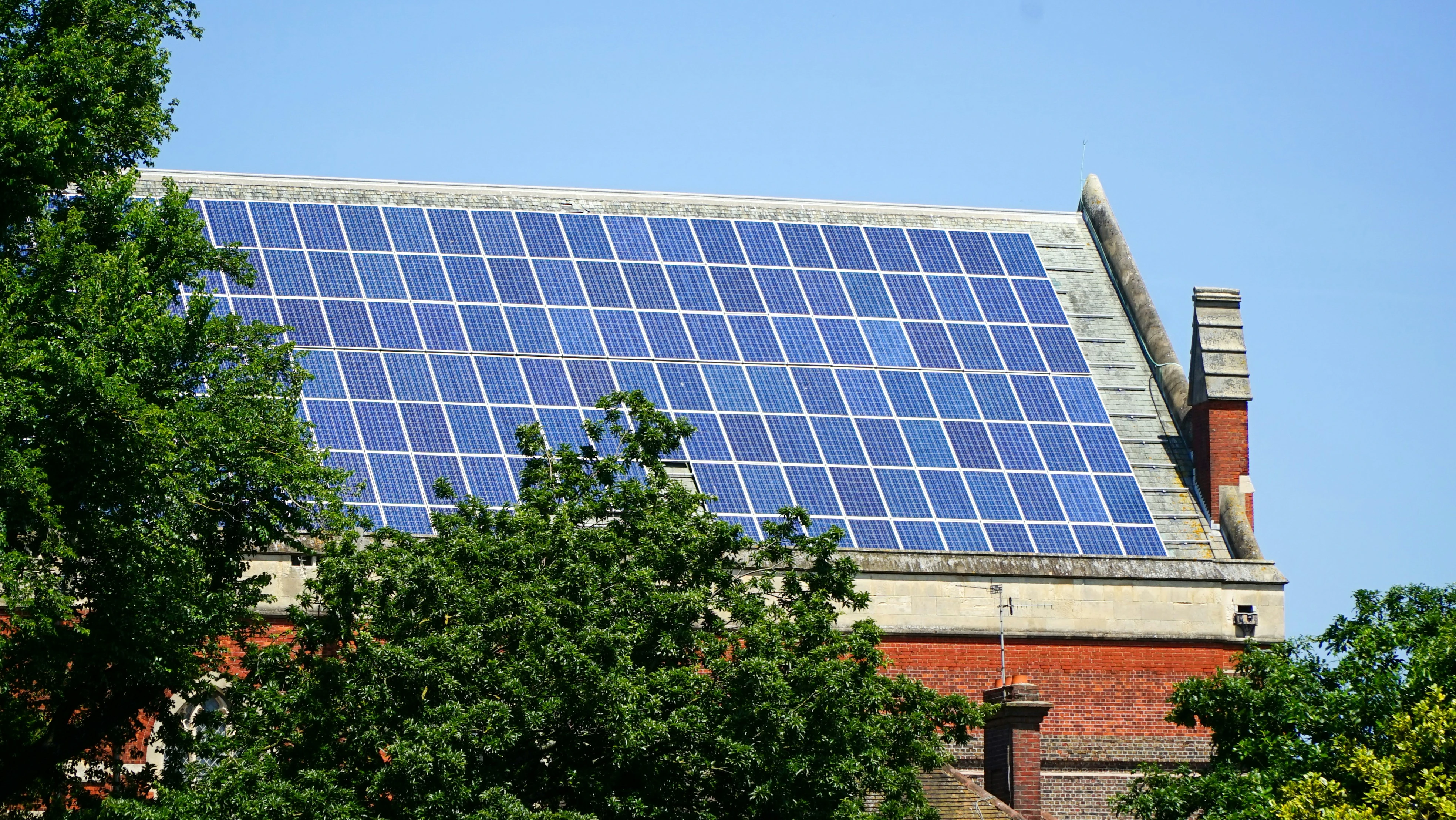
- Rooftop solar panels can reduce dependence on wholesale price swings while cutting Scope 1 and 2 emissions (direct emissions from operations and those from purchased energy), particularly relevant given the Solar Roadmap's push for commercial deployment.
- Power Purchase Agreements (PPAs) can lock in cleaner electricity at scale.
Air-source heat pumps deserve more attention in the business market than they typically receive. The government's Boiler Upgrade Scheme offers grants of up to £7,500 for eligible properties in England and Wales, switching from fossil-fuel heating systems to heat pumps.
In industrial settings, the opportunity can be more significant still: Unilever has reported that its heat-pump system can deliver three to four units of useful heat for every unit of electricity, working alongside waste-heat recovery and other renewable thermal sources, making them well-suited to sites looking to move away from gas-fired low-to-medium temperature heat processes.
Lessons From Businesses That Have Already Acted
The companies that have moved furthest are instructive. Tesco cut its Scope 1 and 2 emissions by 65%, signed the UK's largest corporate solar PPA, and has continued to roll out on-site solar, heat pumps, and natural refrigerants across its estate.
Kingfisher has reduced operational emissions by 66% since 2016/2017, installed air source heat pumps across around 70 sites, and now reports that Sustainable Home Products account for 53.4% of group sales, demonstrating that decarbonisation can become a commercial proposition, not just a cost.
British Land's retrofit of York House replaced gas boilers and chillers with air-source heat pumps, moved the building to full LED, and reported an average carbon payback of 2.5 years with financial ROI within five years.
The takeaway for UK businesses is straightforward. ESG has moved from narrative to an operating model. Reporting requirements are tightening, procurement expectations are spreading through supply chains, and geopolitical shocks keep exposing the cost of fossil-fuel dependence in ways that are immediate and commercial, not theoretical.
Businesses that act early are in a better position to manage energy risk, protect margins, and demonstrate credible plans to customers, investors, and lenders. Those who wait may find the market, the regulator, and their own supply chain have already moved on without them.
Managing the operational side of an ESG or sustainability programme, like tracking energy use, coordinating supplier data, or maintaining audit trails, is a data and workflow challenge as much as a compliance one. If you are working through how to structure that information inside your business, take a look at how Kinabase works.
Recent Articles

AI Workflow Management: How Intelligent Automation is Reshaping the Way Teams Work
AI workflow management uses artificial intelligence to automate, monitor, and optimise business processes — here's what it means for SMEs in 2026.
AS9100 Nonconformance Software: Connecting NCRs, Work Orders, Serials, and CAPA
AS9100 nonconformance software connecting NCRs, work orders, serials, and CAPA in one system — so audit-ready traceability takes minutes, not days.
Digital Transformation Tools for UK Businesses: What to Invest in Right Now
The digital transformation tools UK businesses should prioritise in 2026: cloud, AI automation, integrated data platforms, and cybersecurity.