
Types
Organise records into subtypes
A Type
By grouping Record
Why use types?
- Users only see the fields that matter for the subtype they're creating.
- No need to maintain multiple collections if they share most of their fields - use Types instead.
- Each type can have unique rules, validation, or even Permission Permissions while still living in the same collection.The level of access — No Access, View Only, View & Edit or Not Enabled — granted through a Role for a specific area of Kinabase, such as records, tasks or configuration.
- Colour and icon badges let you visually distinguish types in tables, lists, and configuration screens.
- Requiring a type means the right fields, rules, and permissions apply to every record.
1. Opening the Types pane
You'll need Configure permission for this collection. If you're unsure, ask your System admin.
1. Open the collection
Select the collection in the sidebar.
2. Go to Configure
Right-click the collection, or click the options menu (⋯), and select Configure.
3. Open Types
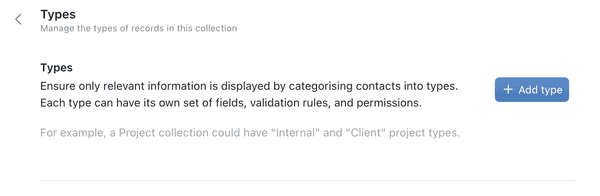
Under Setup, open Types. This shows any existing types and lets you add, remove, or edit them.
2. Creating or editing a type
1. Add or edit a type
Click Add type to create a new type, or click Edit on an existing one.
2. Select a colour
Select a colour from the dropdown palette to the left of the type name - choose from blue, indigo, purple, pink, red, orange, yellow, light-green, green, teal, cyan, or gray.
3. Select an icon
Click the icon picker next to the colour selector and search for an icon that represents the type. The picker suggests icons based on the type name to speed things up.
4. Name the type
Give the type a name, e.g. "Client Project", "Internal Project", or "Resistor", "Capacitor".
5. Select its fields
Tick or untick which fields belong to this type. Any field marked required in the collection's Fields pane stays required across every type.
6. Save
Click Save to confirm.
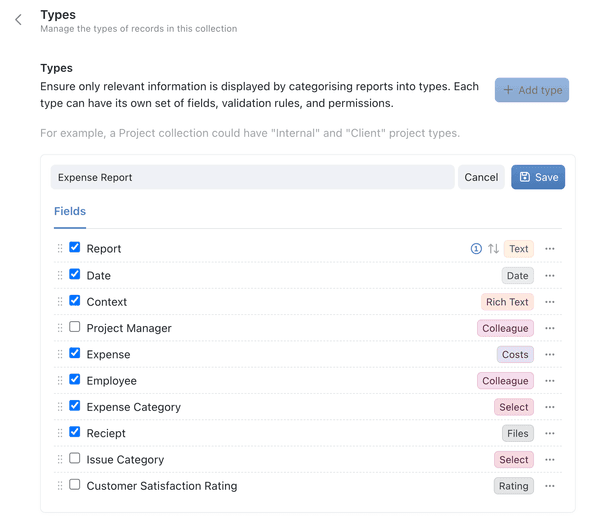
The chosen colour and icon display as a visual badge wherever that type appears, including tables, lists, and configuration screens.
3. Adding a record with a type
When you click + Add to create a new record in the collection:
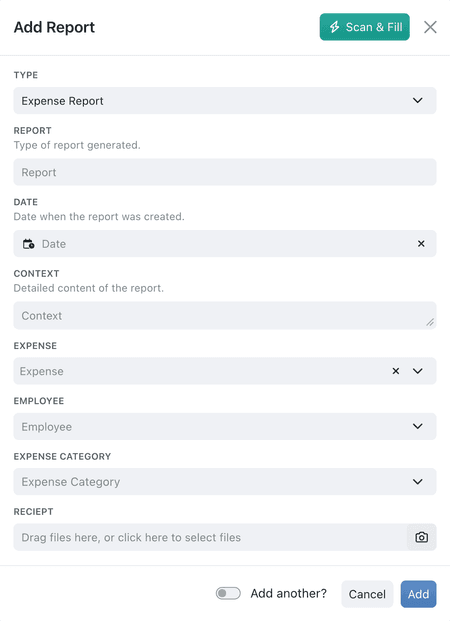
1. Select the type
Select from the types you've created (for example "Client Project" or "Internal Project"). Types can appear as buttons or in a drop-down.
If type is optional, you can leave it blank or, when types appear as buttons, select No type. Once Required is on, that choice is hidden and Type must be completed before the record can be saved.
2. Fill in the relevant fields
Only the fields assigned to that type appear, keeping the form streamlined.
3. Add the record
Kinabase stores the type choice within the record, so you always know which subtype it belongs to.
4. Changing a record's type
Whether an existing record can change type depends on the collection's Type lifecycle setting.
Setting the Type lifecycle
- Open the collection in the sidebar.
- Right-click, or click the ⋯ menu, and select Configure.
- Under Setup, open Types.
- Below your list of types, find the Type lifecycle setting. This section appears once the collection has at least one type.
- Select Fixed to keep types permanent, or Flexible to allow type changes.
- Click Update to save your choice.
Changing an existing record's type
When the Type lifecycle is set to Flexible:
- Open the record and click Edit.
- Select a new type from the type selector in the editor window.
- If any fields would lose data, an inline confirmation lists the affected fields and warns that the change can't be undone.
- Click Change type to proceed, or Go back to cancel.
The same confirmation flow applies when editing multiple records at once.
5. Requiring a type
By default a record can be saved with no type, and the fields, rules, and permissions for a type then do not apply. Turn on Required when every record should be classified before it is saved.
Required lives in Type lifecycle, so it only appears once the collection has at least one type.
1. Open Type lifecycle
In Configure → Types, go to Type lifecycle below your list of types.
2. Turn on Required
Turn on Required. The label uses the collection's singular name - on a Project collection it reads Every project must have a type. Kinabase adds a validation rule so a record cannot be saved without a type.
3. Read the warning if records have no type
If any records have no type, Kinabase opens a Require a type warning. It tells you how many have none, or about how many if the count is an estimate. If the count cannot be confirmed, it says some records may have no type.
The warning explains that those records cannot be saved until each has a type, and advises you to set their types first, or continue and fix them afterwards.
Click Continue to apply the rule, or Cancel to leave Required off.
If every record already has a type, the rule is applied without a warning.
4. Set a type on records that still have none
Open any record that still has no type and set one so it can be saved again. Until it has a type, the record cannot be saved.
Turn off Required if you no longer need every record to have a type.
Need more help? Ask your System admin, or contact our support team via Help & Support.