
Understand User Types
A quick guide to user types in Kinabase
Every person in Kinabase is assigned a user type, which sets the boundaries of what they can access. This article introduces all six, so you can decide who should have which type before you start inviting people.
User types are different from Role
Roles. A user's type sets their system-level access; roles then control which collections and features they can use day to day. See Assign Roles & Permissions for roles.A named set of Permissions you assign to colleagues to control what they can see and do in Kinabase; every organisation also has a built-in Everyone role.
1. The user types
| User type | Who it's for |
|---|---|
| Standard user | Everyone doing day-to-day work in Kinabase. Access is controlled entirely by their roles. |
| System admin | Full access to every part of Kinabase, including all settings. The first person to sign up is automatically a System admin. |
| Billing admin | Billing and subscription management only - no access to collections, settings or roles. |
| Portal user | A user who accesses Kinabase through a portal rather than the main app. |
| Portal-only user | An internal user who only has access via an internal portal, not the full Kinabase interface. |
| External portal user | Someone outside your organisation - a client, vendor or partner - given access to specific data through an external portal. |
2. Standard user
Most people you invite will be Standard users. What they can see and do is entirely determined by the roles you assign them - see Assign Roles & Permissions.
3. System admin
The first person from your organisation to sign up is automatically a System admin - the highest-level user type in Kinabase. A System admin can:
- Access and configure every part of Kinabase, including collections, fields and system-wide settings.
- Invite new users and change their user type.
- Assign or remove other System admins and Billing admins.
Because a System admin has unrestricted access, we recommend keeping this to a few trusted people.
4. Billing admin
A Billing admin manages payments, invoices and subscription details, and nothing else - they can't configure collections or assign roles. This makes the type a good fit for finance or administrative staff who need billing visibility without wider system access.
System admins automatically have billing access too, so you don't need to assign both types to the same person.
See the full Billing Admin Guide for what this type can do.
5. Portal user, Portal-only user and External portal user
These three types cover access through Portals rather than the main Kinabase app:
- Portal user accesses Kinabase through a portal.
- Portal-only user is an internal colleague whose access is limited to an internal portal - useful for field workers or staff who only need a focused set of collections.
- External portal user is someone outside your organisation, given access to specific data through an external portal, with no access to the main Kinabase app.
These types are set up as part of configuring a portal, rather than through the standard invite flow. See Portals for details.
6. User statuses
Alongside their type, every user has a status that shows where they are in the sign-up process:
| Status | Meaning |
|---|---|
| Invited | An invitation has been sent but not yet accepted. |
| Pending verification | The user has started signing up but hasn't verified their email address yet. |
| Active | The user has completed sign-up and can access Kinabase normally. |
| Deactivated | Access has been revoked. Deactivating a user frees up their licence. |
7. Changing a user's type
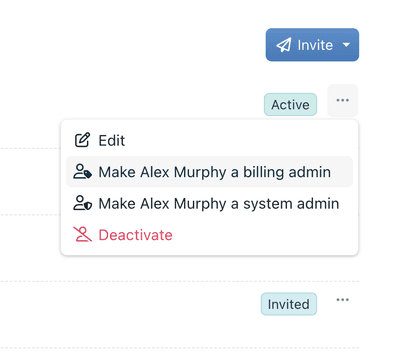
- Go to Settings → Organisation → Users.
- Find the user you want to update and click the options menu (⋯) next to their name.
- Select Change User Type, then select System admin, Billing admin, or Standard user.
Need more help? Ask your System admin, or contact our support team via Help & Support.